Showing posts with label scots. Show all posts

Kathleen Jamie


Kathleen Jamie


Arraheids

See thon raws o flint arraheids
in oor gret museums o antiquities
awful grand in Embro –
Dae’ye near’n daur wunner at wur histrie?
Weel then, Bewaur!
The museums of Scotland are wrang.
They urnae arraheids
but a show o grannies’ tongues,
the hard tongues o grannies
aa deid an gaun
back to thur peat and burns,
but for thur sherp
chert tongues, that lee
fur generations in the land
like wicked cherms, that lee
aa douce in the glessy cases in the gloom
o oor museums, an
they arnae lettin oan. But if you daur
sorn aboot an fancy
the vanished hunter, the wise deer runnin on;
wheesht… an you’ll hear them,
fur they cannae keep fae muttering
ye arnae here tae wonder,

whae dae ye think ye are? 

John Davidson


1931 Collotype John Davidson William Rothenstein Portrait Poet Playwright XADA8


            William Rothstein, collotype, 1931


Snow


'Who affirms that crystals are alive?'

I affirm it, let who will deny:

Crystals are engendered, wax and thrive,

Wane and wither; I have seen them die.


Trust me, masters, crystals have their day,

Eager to attain the perfect norm,

Lit with purpose, potent to display

Facet, angle, colour, beauty, form.


Water-crystals need for flower and root

Sixty clear degrees, no less, no more;

Snow, so fickle, still in this acute

Angle thinks, and learns no other lore:


Such its life, and such its pleasure is,

Such its art and traffic, such its gain,

Evermore in new conjunctions this

Admirable angle to maintain.


Crystalcraft in every flower and flake

Snow exhibits, of the welkin free:

Crystalline are crystals for the sake,

All and singular, of crystalry.


Yet does every crystal of the snow

Individualize, a seedling sown

Broadcast, but instinct with power to grow

Beautiful in beauty of its own.


Every flake with all its prongs and dints

Burns ecstatic as a new-lit star:

Men are not more diverse, finger prints

More dissimilar than snow-flakes are.


Worlds of men and snow endure, increase,

Woven of power and passion to defy

Time and travail: only races cease,

Individual men and crystals die.

© by owner. provided at no charge for educational purposes 

John Davidson


John Davidson, poet

Battle
The war of words is done;
    The red-lipped cannon speak;
  The battle has begun.
  The web your speeches spun
    Tears and blood shall streak;
  The war of words is done.
  Smoke enshrouds the sun;
    Earth staggers at the shriek
  Of battle new begun.

 Poltroons and braggarts run:
  Woe to the poor, the meek!
 The war of words is done.

 "And hope not now to shun
  The doom that dogs the weak,"
 Thunders every gun;

 "Victory must be won."
  When the red-lipped cannon speak,
 The war of words is done,
 The slaughter has begun.

John Davidson

dia


Imagination

There is a dish to hold the sea,   
 A brazier to contain the sun,   
A compass for the galaxy,   
 A voice to wake the dead and done!   
  
That minister of ministers,          
 Imagination, gathers up   
The undiscovered Universe,   
 Like jewels in a jasper cup.   
  
Its flame can mingle north and south;   
 Its accent with the thunder strive;   
The ruddy sentence of its mouth   
 Can make the ancient dead alive.   
  
The mart of power, the fount of will,   
 The form and mould of every star,   
The source and bound of good and ill,    
 The key of all the things that are,   
  
Imagination, new and strange   
 In every age, can turn the year;   
Can shift the poles and lightly change   
 The mood of men, the world's career.

Robert Louis Stevenson


Robert Louis Stevenson, the 19th-century English poet and novelist perhaps best known for his books 'Treasure Island' and the 'Strange Case of Dr Jekyll and Mr Hyde


from The Strange Case of Dr Jekyll and Mr Hyde (1899)

Story of the Door

Mr. Utterson the lawyer was a man of a rugged countenance that was never lighted by a smile; cold, scanty and embarrassed in discourse; backward in sentiment; lean, long, dusty, dreary and yet somehow lovable. At friendly meetings, and when the wine was to his taste, something eminently human beaconed from his eye; something indeed which never found its way into his talk, but which spoke not only in these silent symbols of the after-dinner face, but more often and loudly in the acts of his life. He was austere with himself; drank gin when he was alone, to mortify a taste for vintages; and though he enjoyed the theatre, had not crossed the doors of one for twenty years. But he had an approved tolerance for others; sometimes wondering, almost with envy, at the high pressure of spirits involved in their misdeeds; and in any extremity inclined to help rather than to reprove. “I incline to Cain’s heresy,” he used to say quaintly: “I let my brother go to the devil in his own way.” In this character, it was frequently his fortune to be the last reputable acquaintance and the last good influence in the lives of downgoing men. And to such as these, so long as they came about his chambers, he never marked a shade of change in his demeanour.

Robert Louis Stevenson

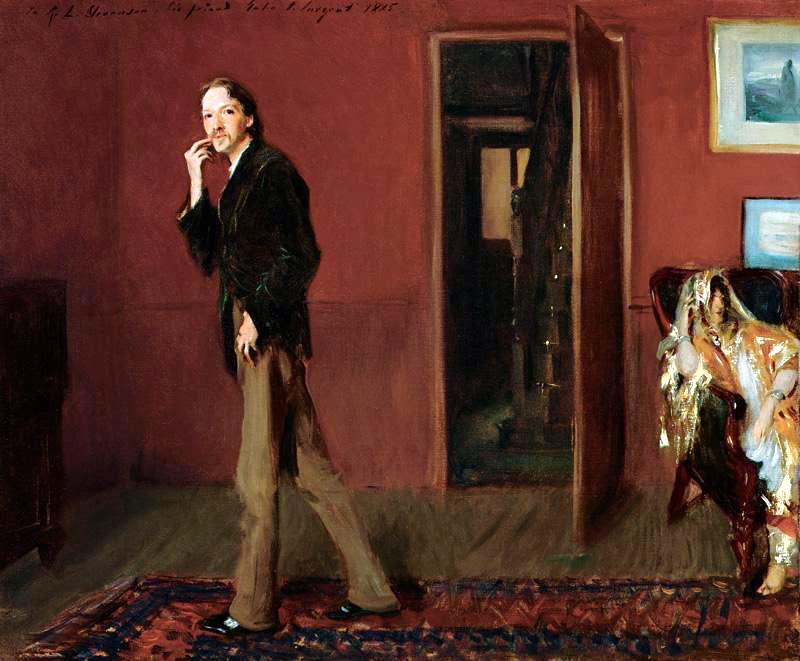
John Singer Sargent. RLS and his wife. 1885


from The American Emigrant 

New York 

For many years America was to me a sort of promised land; ‘westward the march of empire holds its way’; the race is for the moment to the young; what has been and what is we imperfectly and obscurely know; what is to be yet lies beyond the flight of our imaginations.  Greece, Rome, and Judæa are gone by forever, leaving to generations the legacy of their accomplished work; China still endures, an old-inhabited house in the brand-new city of nations; England has already declined, since she has lost the States; and to these States, therefore, yet undeveloped, full of dark possibilities, and grown, like another Eve, from one rib out of the side of their own old land, the minds of young men in England turn naturally at a certain hopeful period of their age.  It will be hard for an American to understand the spirit.  But let him imagine a young man, who shall have grown up in an old and rigid circle, following bygone fashions and taught to distrust his own fresh instincts, and who now suddenly hears of a family of cousins, all about his own age, who keep house together by themselves and live far from restraint and tradition; let him imagine this, and he will have some imperfect notion of the sentiment with which spirited English youths turn to the thought of the American Republic.  It seems to them as if, out west, the war of life was still conducted in the open air, and on free barbaric terms; as if it had not yet been narrowed into parlours, nor begun to be conducted, like some unjust and dreary arbitration, by compromise, costume, forms of procedure, and sad, senseless self-denial.  Which of these two he prefers, a man with any youth still left in him will decide rightly for himself.  He would rather be houseless than denied a pass-key; rather go without food than partake of stalled ox in stiff, respectable society; rather be shot out of hand than direct his life according to the dictates of the world.

He knows or thinks nothing of the Maine Laws, the Puritan sourness, the fierce, sordid appetite for dollars, or the dreary existence of country towns.  A few wild story-books which delighted his childhood form the imaginative basis of his picture of America.  In course of time, there is added to this a great crowd of stimulating details—vast cities that grow up as by enchantment; the birds, that have gone south in autumn, returning with the spring to find thousands camped upon their marshes, and the lamps burning far and near along populous streets; forests that disappear like snow; countries larger than Britain that are cleared and settled, one man running forth with his household gods before another, while the bear and the Indian are yet scarce aware of their approach; oil that gushes from the earth; gold that is washed or quarried in the brooks or glens of the Sierras; and all that bustle, courage, action, and constant kaleidoscopic change that Walt Whitman has seized and set forth in his vigorous, cheerful, and loquacious verses.

Here I was at last in America, and was soon out upon New York streets, spying for things foreign.  The place had to me an air of Liverpool; but such was the rain that not Paradise itself would have looked inviting.  We were a party of four, under two umbrellas; Jones and I and two Scots lads, recent immigrants, and not indisposed to welcome a compatriot.  They had been six weeks in New York, and neither of them had yet found a single job or earned a single halfpenny.  Up to the present they were exactly out of pocket by the amount of the fare.

Robert Louis Stevenson


File:Robert Louis Stevenson by Sargent.jpg

Portrait by John Singer Sargeant, 1887.


Excerpt from Treasure Island

His stories were what frightened people worst of all. Dreadful stories they were; about hanging, and walking the plank, and storms at sea, and the Dry Tortugas, and wild deeds and places on the Spanish Main. By his own account he must have lived his life among some of the wickedest men that God ever allowed upon the sea; and the language in which he told these stories shocked our plain country people almost as much as the crimes that he described. My father was always saying the inn would be ruined, for people would soon cease coming there to be tyrannised over and put down, and sent shivering to their beds; but I really believe his presence did us good. People were frightened at the time, but on looking back they rather liked it; it was a fine excitement in a quiet country life; and there was even a party of the younger men who pretended to admire him, calling him a "true sea-dog," and a "real old salt," and such like names, and saying there was the sort of man that made England terrible at sea.


In one way, indeed, he bade fair to ruin us; for he kept on staying week after week, and at last month after month, so that all the money had been long exhausted, and still my father never plucked up the heart to insist on having more. If ever he mentioned it, the captain blew through his nose so loudly, that you might say he roared, and stared my poor father out of the room. I have seen him wringing his hands after such a rebuff, and I am sure the annoyance and the terror he lived in must have greatly hastened his early and unhappy death.

All the time he lived with us the captain made no change whatever in his dress but to buy some stockings from a hawker. One of the cocks of his hat having fallen down, he let it hang from that day forth, though it was a great annoyance when it blew. I remember the appearance of his coat, which he patched himself up-stairs in his room, and which, before the end, was nothing but patches. He never wrote or received a letter, and he never spoke with any but the neighbours, and with these, for the most part, only when drunk on rum. The great sea-chest none of us had ever seen open.

He was only once crossed, and that was towards the end, when my poor father was far gone in a decline that took him off. Dr. Livesey came late one afternoon to see the patient, took a bit of dinner from my mother, and went into the parlour to smoke a pipe until his horse should come down from the hamlet, for we had no stabling at the old "Benbow." I followed him in, and I remember observing the contrast the neat, bright doctor, with his powder as white as snow, and his bright, black eyes and pleasant manners, made with the coltish country folk, and above all, with that filthy, heavy, bleared scarecrow of a pirate of ours, sitting far gone in rum, with his arms on the table. Suddenly he-the captain, that is-began to pipe up his eternal song:-

"Fifteen men on the dead man's chest-

Yo-ho-ho, and a bottle of rum!

Drink and the devil had done for the rest-

Yo-ho-ho, and a bottle of rum!"

At first I had supposed "the dead man's chest" to be that identical big box of his up-stairs in the front room, and the thought had been mingled in my nightmares with that of the one-legged seafaring man. But by this time we had all long ceased to pay any particular notice to the song; it was new, that night, to nobody but Dr. Livesey, and on him I observed it did not produce an agreeable effect, for he looked up for a moment quite angrily before he went on with his talk to old Taylor, the gardener, on a new cure for the rheumatics. In the meantime, the captain gradually brightened up at his own music, and at last flapped his hand upon the table before him in a way we all knew to mean-silence. The voices stopped at once, all but Dr. Livesey's; he went on as before, speaking clear and kind, and drawing briskly at his pipe between every word or two. The captain glared at him for a while, flapped his hand again, glared still harder, and at last broke out with a villainous, low oath: "Silence, there, between decks!"

D. H. Lawrence

 from Pansies THE WHITE HORSE The youth walks up to the white horse, to put its halter on and the horse looks at him in silence. They are s...