Showing posts with label women. Show all posts

Barbara Guest


Out of the Peter Schjeldahl and Lewis MacAdams-edited Mother: A Journal of New Literature(No. 6, 1965):

Prefaces

Wrrite thatt lline
         the beasts rruning
and quail as were
         ffeathers

Twice
I think the novel should begin here
                  Three pairs
                  and a roop
Someone should put us together:
                  The laugh
                                     knock door
                  foresight

                  Flush as bush
And         nd
We are          re

Gwendolyn Brooks


kitchenette building

We are things of dry hours and the involuntary plan,

Grayed in, and gray. “Dream” makes a giddy sound, not strong

Like “rent,” “feeding a wife,” “satisfying a man.”

But could a dream send up through onion fumes

Its white and violet, fight with fried potatoes

And yesterday’s garbage ripening in the hall,

Flutter, or sing an aria down these rooms

Even if we were willing to let it in,

Had time to warm it, keep it very clean,

Anticipate a message, let it begin?

We wonder. But not well! not for a minute!

Since Number Five is out of the bathroom now,

We think of lukewarm water, hope to get in it.

Virginia Woolf

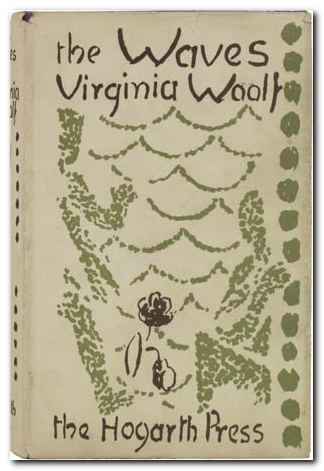
The Waves cover

The Waves - first edition

from The Waves (1931)


‘I see a ring,’ said Bernard, ‘hanging above me. It quivers and hangs in a loop of light.’

‘I see a slab of pale yellow,’ said Susan, ‘spreading away until it meets a purple stripe.’

‘I hear a sound,’ said Rhoda, ‘cheep, chirp; cheep chirp; going up and down.’

‘I see a globe,’ said Neville, ‘hanging down in a drop against the enormous flanks of some hill.’

‘I see a crimson tassel,’ said Jinny, ‘twisted with gold threads.’

‘I hear something stamping,’ said Louis. ‘A great beast’s foot is chained. It stamps, and stamps, and stamps.’

‘Look at the spider’s web on the corner of the balcony,’ said Bernard. ‘It has beads of water on it, drops of white light.’

‘The leaves are gathered round the window like pointed ears,’ said Susan.

‘A shadow falls on the path,’ said Louis, ‘like an elbow bent.’

Dorothy Richardson


Dorothy Richardson in 1932, about a year after Dawn's Left Hand was published

 It gratified her to discover that she could, at the end of this one day, understand or at the worst gather the drift of, all she heard, both of German and French. Mademoiselle had exclaimed at her French—les mots si bien choisis—un accent sans faute—it must be ear. She must have a very good ear. And her English was all right—at least, if she chose…. Pater had always been worrying about slang and careless pronunciation. None of them ever said “cut in half” or “very unique” or “ho’sale” or “phodygraff.” She was awfully slangy herself—she and Harriett were, in their thoughts as well as their words—but she had no provincialisms, no Londonisms—she could be the purest Oxford English. There was something at any rate to give her German girls…. She could say, “There are no rules for English pronunciation, but what is usual at the University of Oxford is decisive for cultured people”—“decisive for cultured people.” She must remember that for the class. […]

                                                            from Painted Roofs?

Dorothy Richardson

List of works by Richardson from verso of Deadlock.

 “She struggled in thought to discover why it was she felt that these people did not read books and that she herself did. She felt that she could look at the end, and read here and there a little and know; know something, something they did not know. People thought it was silly, almost wrong to look at the end of a book. But if it spoilt a book, there was something wrong about the book. If it was finished and the interest gone when you know who married who, what was the good of reading at all? It was a sort of trick, a sell. Like a puzzle that was no more fun when you had found it out. There was something more in books than that. . even Rosa Nouchette Carey and Mrs. Hungerford, something that came to you out of the book, any bit of it, a page, even a sentence - and the "stronger" the author was the more came.” 

―from Honeycomb

Jane Kenyon


Otherwise

I got out of bed 

on two strong legs. 
It might have been 
otherwise. I ate 
cereal, sweet 
milk, ripe, flawless 
peach. It might 
have been otherwise. 
I took the dog uphill 
to the birch wood. 
All morning I did 
the work I love. 

At noon I lay down 
with my mate. It might 
have been otherwise. 
We ate dinner together 
at a table with silver 
candlesticks. It might 
have been otherwise. 
I slept in a bed 
in a room with paintings 
on the walls, and 
planned another day 
just like this day. 
But one day, I know, 
it will be otherwise.

Edna St. Vincent Millay

To the Maid of Orleans by Edna St. Vincent Millay. 1940.

"Loving you less than life, a little less"

Loving you less than life, a little less
Than bitter-sweet upon a broken wall
Or bush-wood smoke in autumn, I confess
I cannot swear I love you not at all.
For there is that about you in this light--
A yellow darkness, sinister of rain--
Which sturdily recalls my stubborn sight
To dwell on you, and dwell on you again.
And I am made aware of many a week
I shall consume, remembering in what way
Your brown hair grows about your brow and cheek,
And what divine absurdities you say:
Till all the world, and I, and surely you,
Will know I love you, whethe

Edna St. Vincent Millay


 “What lips my lips have kissed, and where, and why”

What lips my lips have kissed, and where, and why,
I have forgotten, and what arms have lain
Under my head till morning; but the rain
Is full of ghosts tonight, that tap and sigh
Upon the glass and listen for reply,
And in my heart there stirs a quiet pain
For unremembered lads that not again
Will turn to me at midnight with a cry.

Thus in the winter stands the lonely tree,
Nor knows what birds have vanished one by one,
Yet knows its boughs more silent than before:
I cannot say what loves have come and gone,
I only know that summer sang in me
A little while, that in me sings no more.

Edna St. Vincent Benet

 Edna St. Vincent Millay

II 

I think I should have loved you presently, 
And given in earnest words I flung in jest; 
And lifted honest eyes for you to see, 
And caught your hand against my cheek and breast; 
And all my pretty follies flung aside 
That won you to me, and beneath your gaze, 
Naked of reticence and shorn of pride, 
Spread like a chart my little wicked ways. 
I, that had been to you, had you remained, 
But one more waking from a recurrent dream, 
Cherish no less the certain stakes I gained, 
And walk your memory's halls, austere, supreme, 
A ghost in marble of a girl you knew 
Who would have loved you in a day or two. 

IV 
I shall forget you presently, my dear, 
So make the most of this, your little day, 
Your little month, your little half a year, 
Ere I forget, or die, or move away, 
And we are done forever; by and by 
I shall forget you, as I said, but now, 
If you entreat me with your loveliest lie 
I will protest you with my favorite vow. 
I would indeed that love were longer-lived, 
And vows were not so brittle as they are, 
But so it is, and nature has contrived 
To struggle on without a break thus far, — 
Whether or not we find what we are seeking 
Is idle, biologically speaking. 

Edna St. Vincent Millay

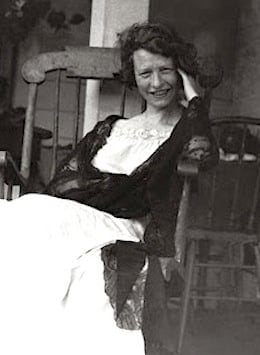
Edna St. Vincent Millay at Steepletop

“Time does not bring relief; you all have lied”

Time does not bring relief; you all have lied   
Who told me time would ease me of my pain!   
I miss him in the weeping of the rain;   
I want him at the shrinking of the tide;
The old snows melt from every mountain-side,   
And last year’s leaves are smoke in every lane;   
But last year’s bitter loving must remain
Heaped on my heart, and my old thoughts abide.   
There are a hundred places where I fear   
To go,—so with his memory they brim.   
And entering with relief some quiet place   
Where never fell his foot or shone his face   
I say, “There is no memory of him here!”   
And so stand stricken, so remembering him.

Lorine Niedecker


[Mr. Van Ess bought 14 washcloths?]

Mr. Van Ess bought 14 washcloths?
Fourteen washrags, Ed Van Ess?
Must be going to give em
to the church, I guess.

He drinks, you know. The day we moved
he came into the kitchen stewed,
mixed things up for my sister Grace—
put the spices in the wrong place

Lorine Niedecker


In the great snowfall before the bomb


In the great snowfall before the bomb
colored yule tree lights
windows, the only glow for contemplation
along this road 

I worked the print shop
right down among em
the folk from whom all poetry flows
and dreadfully much else. 

I was Blondie
I carried my bundles of hog feeder price lists
down by Larry the Lug,
I’d never get anywhere
because I’d never had suction,
pull, you know, favor, drag,
well-oiled protection. 

I heard their rehashed radio barbs—
more barbarous among hirelings
as higher-ups grow more corrupt.
But what vitality! The women hold jobs—
clean house, cook, raise children, bowl
and go to church. 

What would they say if they knew
I sit for two months on six lines
of poetry?

Jean Garrigue


Image for FIVE YOUNG AMERICAN POETS. Third Series; Association Copy


Catch What You Can

The thing to do is try for that sweet skin 
One gets by staying deep inside a thing. 
The image that I have is that of fruit— 
The stone within the plum or some such pith 
As keeps the slender sphere both firm and sound. 
Stay with me, mountain flowers I saw 
And battering moth against a wind-dark rock,
Stay with me till you build me all around 
The honey and the clove I thought to taste 
If lingering long enough I lived and got 
Your intangible wild essence in my heart. 
And whether that's by sight or thought 
Or staying deep inside an aerial shed 
Till imagination makes the heart-leaf vine 
Out of damned bald rock, I cannot guess. 
The game is worth the candle if there's flame

Jean Garrigue

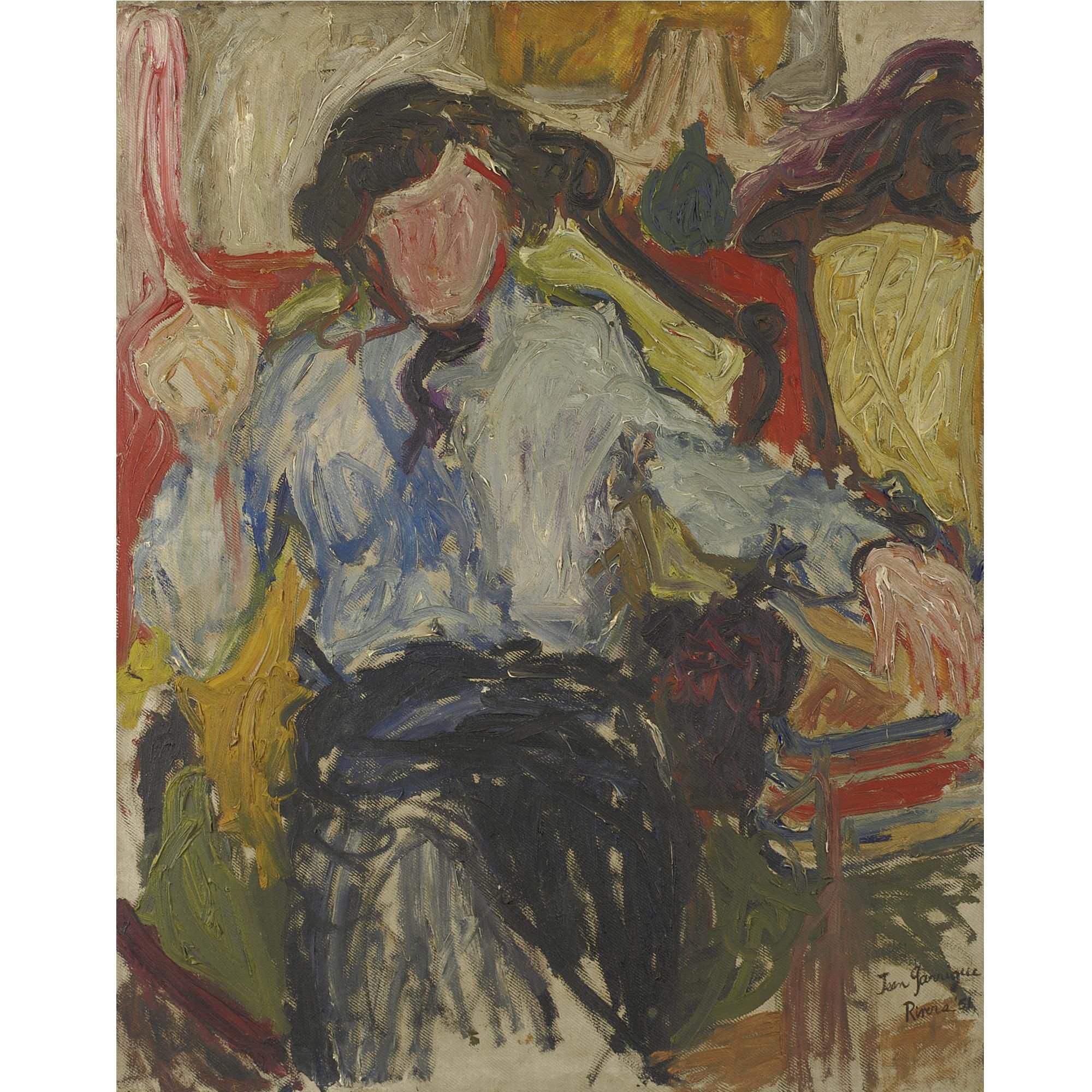
 Artwork by Larry Rivers, Jean Garrigue, Made of oil on canvas 

                    portrait by Larry Rivers

Song

O beautiful, my relic bone, 
Whitening like the foreign moon, 
Whose luster consummates my tomb. 

O beautiful, my fresh rose-grown, 
Rose-rose white from that small bone 
Whose vapor is the breath I own 

And tendrils of my blood curl in. 
Rose-rose white, the flesh I am 
But murderer eye and murdered! 

For all the flesh becomes an eye: 
I am no flesh while yet eye's eaten 
The rose-rose flesh bare to the bone, 

Bare to the bone! But that flesh still 
By heat of dews renews again 

O bless, occurrence of the moon 
When actual flesh of the both is gone, 
My flesh the air the eye takes in, 

That flesh on bone the air the eye takes in, 
Death-wedding the moon shines in

Jean Garrigue


File:Image 8 Garrigue1.tif


                                        Some Serious Nonsense for the Cats and Wolves


                                                         My cat peed in the coalbin, why?

Well, God himself asks many things
And gives no reason for the sky.
If we get used to life, that is the crime
Though distant evils rise and shine.
My cat peed in the coalbin, why?
The coal will smell of whitefish when it lights
And mildest milk and small long bones
Will snatch a smoke to saunter through the skies
Or God himself will get a fire of rose
To hail the stars that watch our life of lies.
(Damn those pretty snakelike jaws!
I woke to hear her scrabbling in the coals!)
My cat peed in the coalbin, why?
Pray him cat's watered coals are not the worst
He gets from us, committed to our wars.
Pray him some natural good survive
Th' exploding ditch it seems he's left us by ­
This world that throws its darlings to the wolves!
My cat peed in the coalbin, why?
Well, God collect, forgive, and smile upon
Cats mad, abused, somewhat the idiot, who
Wish their sweets to amble through the clouds.
It is their schemeless arrogance perhaps
That keeps what's left in order, one might think,
Our offerings stench by that salubrious stink.

Think of the dead who multiply!
Think of the living now who mortify!


Jean Garrigue

Jazz Bit

 Go lift that pane of moonlight from the floor

And tell Nicotiana to stop 
Screaming with her perfume. 
The Four O’clocks too. They’re drunk with dew. 

I gotta date with a hoot owl, 
I gotta date with a whoo. 
Wait for the bird. By the moon-soaked wall. 
By the insect’s hairy legs. 
Wait for that green funeral 
Of the cricket in a pall 
And for the knell that tolls a moth. 
A vast robin as well 
Of the invisible wound that kills a crow. 
Wait till the master of all vermin, 
Presiding genius of the graves,
Comes with his rats, mice, frogs, toads and bugs. 
“Light, I salute thee with wounded nerves.”

Anne Sexton


The Kiss

My mouth blooms like a cut.
I've been wronged all year, tedious
nights, nothing but rough elbows in them
and delicate boxes of Kleenex calling crybaby
crybaby , you fool ! 

Before today my body was useless.
Now it's tearing at its square corners.
It's tearing old Mary's garments off, knot by knot
and see — Now it's shot full of these electric bolts.
Zing! A resurrection!

Once it was a boat, quite wooden
and with no business, no salt water under it
and in need of some paint. It was no more
than a group of boards. But you hoisted her, rigged her.
She's been elected.

My nerves are turned on. I hear them like
musical instruments. Where there was silence
the drums, the strings are incurably playing. You did this.
Pure genius at work. Darling, the composer has stepped
into fire.

Ann Sexton

Anne Sexton’s family


Music Swims Back To Me

Wait Mister. Which way is home? 

They turned the light out 
and the dark is moving in the corner. 
There are no sign posts in this room, 
four ladies, over eighty, 
in diapers every one of them. 
La la la, Oh music swims back to me 
and I can feel the tune they played 
the night they left me 
in this private institution on a hill. 

Imagine it. A radio playing 
and everyone here was crazy. 
I liked it and danced in a circle. 
Music pours over the sense 
and in a funny way 
music sees more than I. 
I mean it remembers better; 
remembers the first night here. 
It was the strangled cold of November; 
even the stars were strapped in the sky 
and that moon too bright 
forking through the bars to stick me 
with a singing in the head. 
I have forgotten all the rest. 

They lock me in this chair at eight a.m. 
and there are no signs to tell the way, 
just the radio beating to itself 
and the song that remembers 
more than I. Oh, la la la, 
this music swims back to me. 
The night I came I danced a circle 
and was not afraid. 
Mister?

Anne Sexton


                scrapbook Virginia Beach (1948-1949)


With Mercy for the Greedy

For my friend, Ruth, who urges me to make an appointment for the Sacrament of Confession

Concerning your letter in which you ask   
me to call a priest and in which you ask   
me to wear The Cross that you enclose;   
your own cross,
your dog-bitten cross,
no larger than a thumb,
small and wooden, no thorns, this rose—

I pray to its shadow,
that gray place
where it lies on your letter ... deep, deep.
I detest my sins and I try to believe
in The Cross. I touch its tender hips, its dark jawed face,   
its solid neck, its brown sleep.

True. There is
a beautiful Jesus.
He is frozen to his bones like a chunk of beef.
How desperately he wanted to pull his arms in!
How desperately I touch his vertical and horizontal axes!   
But I can’t. Need is not quite belief.

All morning long   
I have worn
your cross, hung with package string around my throat.   
It tapped me lightly as a child’s heart might,
tapping secondhand, softly waiting to be born.   
Ruth, I cherish the letter you wrote.

My friend, my friend, I was born   
doing reference work in sin, and born   
confessing it. This is what poems are:   
with mercy
for the greedy,
they are the tongue’s wrangle,
the world's pottage, the rat's star.

D. H. Lawrence

 from Pansies THE WHITE HORSE The youth walks up to the white horse, to put its halter on and the horse looks at him in silence. They are s...