Showing posts with label realism. Show all posts

Theodore Dreiser


File:TheGenius.jpg


from The Genius (1915)

 The old Art Institute, which preceded the present impressive structure, was located at Michigan Avenue and Monroe Street, and presented an atmosphere of distinction which was not present in most of the structures representing the public taste of the period. It was a large six storey building of brown stone, and contained a number of studios for painters, sculptors, and music teachers, besides the exhibition rooms and the rooms for the classes. There were both day and evening classes, and even at that time a large number of students. The western soul, to a certain extent, was fired by the wonder of art. There was so little of it in the life of the people—the fame of those who could accomplish things in this field and live in a more refined atmosphere was great. To go to Paris! To be a student in any one of the great ateliers of that city! Or of Munich or Rome, to know the character of the artistic treasures of Europe—the life of the Art quarter—that was something. There was what might have been termed a wild desire in the breast of many an untutored boy and girl to get out of the ranks of the commonplace; to assume the character and the 

[Pg 51]habiliments of the artistic temperament as they were then supposed to be; to have a refined, semi-languorous, semi-indifferent manner; to live in a studio, to have a certain freedom in morals and temperament not accorded to the ordinary person—these were the great things to do and be. Of course, art composition was a part of this. You were supposed ultimately to paint great pictures or do noble sculptures, but in the meanwhile you could and should live the life of the artist. And that was beautiful and wonderful and free.

Eugene had long had some sense of this. He was aware that there were studios in Chicago; that certain men were supposed to be doing good work—he saw it in the papers. There were mentions now and then of exhibitions, mostly free, which the public attended but sparingly. Once there was an exhibition of some of the war pictures of Verestchagin, a great Russian painter who had come West for some purpose. Eugene saw them one Sunday afternoon, and was enthralled by the magnificence of their grasp of the elements of battle; the wonder of color; the truth of character; the dramatic quality; the sense of force and danger and horror and suffering which was somehow around and in and through everything that was shown. This man had virility and insight; stupendous imagination and temperament. Eugene stood and stared, wondering how such things could be done. Ever afterward the name of Verestchagin was like a great call to his imagination; that was the kind of an artist to be if you were going to be one.

Another picture came there once, which appealed to another side of his nature, although primarily the basis of its appeal was artistic. It was a great, warm tinted nude by Bouguereau, a French artist who was startling his day with his daring portrayal of the nude. The types he depicted were not namby-pamby little slim-bodied women with spindling qualities of strength and passion, but great, full-blown women whose voluptuous contour of neck and arms and torso and hip and thigh was enough to set the blood of youth at fever heat. The man obviously understood and had passion, love of form, love of desire, love of beauty. He painted with a sense of the bridal bed in the background; of motherhood and of fat, growing babies, joyously nursed. These women stood up big in their sense of beauty and magnetism, the soft lure of desire in their eyes, their full lips parted, their cheeks flushed with the blood of health. As such they were anathema to the conservative and puritanical in mind, the religious in temperament, the [Pg 52]cautious in training or taste. The very bringing of this picture to Chicago as a product for sale was enough to create a furore of objection. Such pictures should not be painted, was the cry of the press; or if painted, not exhibited. Bouguereau was conceived of by many as one of those dastards of art who were endeavoring to corrupt by their talent the morals of the world; there was a cry raised that the thing should be suppressed; and as is always the case in all such outbursts of special class opposition, the interest of the general public was aroused.

*****

There were other exhibitions—one containing a genuine Rembrandt—which [Pg 53]impressed him, but none like these that had definitely stirred him. His interest in art was becoming eager. He wanted to find out all about it—to do something himself. One day he ventured to call at the Art Institute building and consult the secretary, who explained to him what the charges were. He learned from her, for she was a woman of a practical, clerical turn, that the classes ran from October to May, that he could enter a life or antique class or both, though the antique alone was advisable for the time, and a class in illustration, where costumes of different periods were presented on different models. He found that each class had an instructor of supposed note, whom it was not necessary for him to see. Each class had a monitor and each student was supposed to work faithfully for his own benefit. Eugene did not get to see the class rooms, but he gained a sense of the art of it all, nevertheless, for the halls and offices were decorated in an artistic way, and there were many plaster casts of arms, legs, busts, and thighs and heads. It was as though one stood in an open doorway and looked out upon a new world. The one thing that gratified him was that he could study pen and ink or brush in the illustration class, and that he could also join a sketch class from five to six every afternoon without extra charges if he preferred to devote his evening hours to studying drawing in the life class. He was a little astonished to learn from a printed prospectus given him that the life class meant nude models to work from—both men and women. He was surely approaching a different world now. It seemed necessary and natural enough, and yet there was an aloof atmosphere about it, something that suggested the inner precincts of a shrine, to which only talent was admitted. Was he talented? Wait! He would show the world, even if he was a raw country boy.

Theodore Dreiser

File:Theodore Dreiser 1.jpg

(1917)

from An American Tragedy (1925)

The boy moved restlessly from one foot to the other, keeping his eyes down, and for the most part only half singing. A tall and as yet slight figure, surmounted by an interesting head and face—white skin, dark hair—he seemed more keenly observant and decidedly more sensitive than most of the others—appeared indeed to resent and even to suffer from the position in which he found himself. Plainly pagan rather than religious, life interested him, although as yet he was not fully aware of this. All that could be truly said of him now was that there was no definite appeal in all this for him. He was too young, his mind much too responsive to phases of beauty and pleasure which had little, if anything, to do with the remote and cloudy romance which swayed the minds of his mother and father.

******

To-night, walking up the great street with his sisters and brother, he wished that they need not do this any more, or at least that he need not be a part of it. Other boys did not do such things, and besides, somehow it seemed shabby and even degrading. On more than one occasion, before he had been taken on the street in this fashion, other boys had called to him and made fun of his father, because he was always publicly emphasizing his religious beliefs or convictions. Thus in one neighborhood in which they had lived, when he was but a child of seven, his father, having always precluded every conversation with “Praise the Lord,” he heard boys call “Here comes the old Praise-the-Lord Griffiths.” Or they would call out after him “Hey, you’re the fellow whose sister plays the organ. Is there anything else she can play?”

Theodore Dreiser


from Sister Carrie (1900)

When Carrie Meeber boarded the afternoon train for Chicago, her total outfit consisted of a small trunk, a cheap imitation alligator-skin satchel, a small lunch in a paper box, and a yellow leather snap purse, containing her ticket, a scrap of paper with her sister's address in Van Buren Street, and four dollars in money. It was in August, 1889. She was eighteen years of age, bright, timid, and full of the illusions of ignorance and youth. Whatever touch of regret at parting characterized her thoughts, it was certainly not for advantages now being given up. A gush of tears at her mother's farewell kiss, a touch in her throat when the cars clacked by the flour mill where her father worked by the day, a pathetic sigh as the familiar green environs of the village passed in review, and the threads which bound her so lightly to girlhood and home were irretrievably broken.

To be sure there was always the next station, where one might descend and return. There was the great city, bound more closely by these very trains which came up daily. Columbia City was not so very far away, even once she was in Chicago. What, pray, is a few hours—a few hundred miles? She looked at the little slip bearing her sister's address and wondered. She gazed at the green landscape, now passing in swift review, until her swifter thoughts replaced its impression with vague conjectures of what Chicago might be.

Harold Frederick


from The Copperhead (1893)


Chapter 1 Abner Beech

***** At all times—even when nothing else good was said of him—Abner Beech was spoken of by the people of the district as a “great hand for reading.” His pre-eminence in this matter remained unquestioned to the end. No other farmer for miles owned half the number of books which he had on the shelves above his writing-desk. Still less was there anyone roundabout who could for a moment stand up with him in a discussion involving book-learning in general. This at first secured for him the respect of the whole country-side, and men were proud to be agreed with by such a scholar. But when affairs changed, this, oddly enough, became a formidable popular grievance against Abner Beech. They said then that his opinions were worthless because he got them from printed books, instead of from his heart.

What these opinions were may in some measure be guessed from the titles of the farmer's books. Perhaps there were some thirty of them behind the glass doors of the old mahogany bookcase. With one or two agricultural or veterinary exceptions, they related exclusively to American history and politics. There were, I recall, the first two volumes of Bancroft, and Lossing's “Lives of the Signers,” and “Field-Books” of the two wars with England; Thomas H. Benton's “Thirty Years' View;” the four green-black volumes of Hammond's “Political History of the State of New York;” campaign lives of Lewis Cass and Franklin Pierce, and larger biographies of Jefferson and Jackson, and, most imposing of all, a whole long row of big calf-bound volumes of the Congressional Globe, which carried the minutiæ of politics at Washington back into the forties.

These books constituted the entire literary side of my boyish education. I have only the faintest and haziest recollections of what happened when I went during the winter months to the school-house at the Four Corners. But I can recall the very form of the type in the farmer's books. Everyone of those quaint, austere, and beardless faces, framed in high collars and stocks and waving hair—the Marcys, Calhouns, DeWitt Clintons, and Silas Wrights of the daguerreotype and Sartain's primitive graver—gives back to me now the lineaments of an old-time friend.

Harold Frederick

                                            poster, John Henry Twachtman


from The Damnation of Theron Ware or Illumination. Chicago, Stone and Kimball(1896)

 The unusually large local attendance upon the sessions of the Conference had given some of the more guileless of visiting brethren a high notion of Tecumseh’s piety; and perhaps even the most sophisticated stranger never quite realized how strictly it was to be explained by the anxiety to pick out a suitable champion for the fierce Pres- byterian competition. Big gatherings assembled evening after evening to hear the sermons of those selected to preach, and the church had been almost impossibly crowded at each of the three Sunday services. Opinions had naturally differed a good deal during the earlier stages of this scrutiny, but after last night’s sermon there could be but one feeling. The man for Tecumseh was the Reverend Theron Ware.


The choice was an admirable one, from points of view much more exalted than those of the local congregation.

You could see Mr. Ware sitting there at the end of the row inside the altar-rail—the tall, slender young man with the broad white brow, thoughtful eyes, and features moulded into that regularity of strength which used to characterize the American Senatorial type in those far-away days of clean-shaven faces and moderate incomes before the War. The bright-faced, comely, and vivacious young woman in the second side pew was his wife—and Tecumseh noted with approbation that she knew how to dress. There were really no two better or worthier people in the building than this young couple, who sat waiting along with the rest to hear their fate. But unhappily they had come to know of the effort being made to bring them to Tecumseh, and their simple pride in the triumph of the husband’s fine sermon had become swallowed up in a terribly anxious conflict of hope and fear. Neither of them could maintain a satisfactory show of composure as the decisive moment approached. The vision of translation from poverty and obscurity to such a splendid post as this—truly it was too dazzling for tranquil nerves.

Vachel Lindsay

Vachel Lindsay’s “The Potatoes’ Dance” from one of his “poem-games.” - IMAGES COURTESY IAN WINTERBAUER

        "Potato Dance" poem-game 


The Flower-Fed Buffaloes

The flower-fed buffaloes of the spring
In the days of long ago,
Ranged where the locomotives sing
And the prairie flowers lie low:—
The tossing, blooming, perfumed grass
Is swept away by the wheat,
Wheels and wheels and wheels spin by
In the spring that still is sweet.
But the flower-fed buffaloes of the spring
Left us, long ago.
They gore no more, they bellow no more,
They trundle around the hills no more:—
With the Blackfeet, lying low,
With the Pawnee, lying low,

Lying low.

Vachel Lindsay

 Vachel Lindsay


St. Francis of Assisi

Would I might wake St. Francis in you all, 

Brother of birds and trees, God's Troubadour, 
Blinded with weeping for the sad and poor; 
Our wealth undone, all strict Franciscan men, 
Come, let us chant the canticle again 
Of mother earth and the enduring sun. 
God make each soul the lonely leper's slave; 
God make us saints, and brave.

Vachel Lindsay


Niagara


I

Within the town of Buffalo
Are prosy men with leaden eyes.
Like ants they worry to and fro,
(Important men, in Buffalo.)
But only twenty miles away
A deathless glory is at play:
Niagara, Niagara.

The women buy their lace and cry: —
"O such a delicate design,"
And over ostrich feathers sigh,
By counters there, in Buffalo.
The children haunt the trinket shops,
They buy false-faces, bells, and tops,
Forgetting great Niagara.

Within the town of Buffalo
Are stores with garnets, sapphires, pearls,
Rubies, emeralds aglow, —
Opal chains in Buffalo,
Cherished symbols of success.
They value not your rainbow dress: —
Niagara, Niagara.

The shaggy meaning of her name
This Buffalo, this recreant town,
Sharps and lawyers prune and tame:
Few pioneers in Buffalo;
Except young lovers flushed and fleet
And winds hallooing down the street:
"Niagara, Niagara."

The journalists are sick of ink:
Boy prodigals are lost in wine,
By night where white and red lights blink,
The eyes of Death, in Buffalo.
And only twenty miles away
Are starlit rocks and healing spray: —
Niagara, Niagara.

Above the town a tiny bird,
A shining speck at sleepy dawn,
Forgets the ant-hill so absurd,
This self-important Buffalo.
Descending twenty miles away
He bathes his wings at break of day —
Niagara, Niagara.

II

What marching men of Buffalo
Flood the streets in rash crusade?
Fools-to-free-the-world, they go,
Primeval hearts from Buffalo.
Red cataracts of France today
Awake, three thousand miles away
An echo of Niagara,
The cataract Niagara.


Charlotte Perkins Gilman


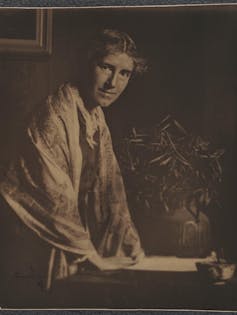
Sepia photograph

from Herland (1915)

CHAPTER 7. Our Growing Modesty

Being at last considered sufficiently tamed and trained to be trusted with scissors, we barbered ourselves as best we could. A close-trimmed beard is certainly more comfortable than a full one. Razors, naturally, they could not supply.

“With so many old women you’d think there’d be some razors,” sneered Terry. Whereat Jeff pointed out that he never before had seen such complete absence of facial hair on women.

“Looks to me as if the absence of men made them more feminine in that regard, anyhow,” he suggested.

“Well, it’s the only one then,” Terry reluctantly agreed. “A less feminine lot I never saw. A child apiece doesn’t seem to be enough to develop what I call motherliness.”

Terry’s idea of motherliness was the usual one, involving a baby in arms, or “a little flock about her knees,” and the complete absorption of the mother in said baby or flock. A motherliness which dominated society, which influenced every art and industry, which absolutely protected all childhood, and gave to it the most perfect care and training, did not seem motherly—to Terry.

We had become well used to the clothes. They were quite as comfortable as our own—in some ways more so—and undeniably better looking. As to pockets, they left nothing to be desired. That second garment was fairly quilted with pockets. They were most ingeniously arranged, so as to be convenient to the hand and not inconvenient to the body, and were so placed as at once to strengthen the garment and add decorative lines of stitching.

In this, as in so many other points we had now to observe, there was shown the action of a practical intelligence, coupled with fine artistic feeling, and, apparently, untrammeled by any injurious influences.

Our first step of comparative freedom was a personally conducted tour of the country. No pentagonal bodyguard now! Only our special tutors, and we got on famously with them. Jeff said he loved Zava like an aunt—“only jollier than any aunt I ever saw”; Somel and I were as chummy as could be—the best of friends; but it was funny to watch Terry and Moadine. She was patient with him, and courteous, but it was like the patience and courtesy of some great man, say a skilled, experienced diplomat, with a schoolgirl. Her grave acquiescence with his most preposterous expression of feeling; her genial laughter, not only with, but, I often felt, at him—though impeccably polite; her innocent questions, which almost invariably led him to say more than he intended—Jeff and I found it all amusing to watch.

He never seemed to recognize that quiet background of superiority. When she dropped an argument he always thought he had silenced her; when she laughed he thought it tribute to his wit.

I hated to admit to myself how much Terry had sunk in my esteem. Jeff felt it too, I am sure; but neither of us admitted it to the other. At home we had measured him with other men, and, though we knew his failings, he was by no means an unusual type. We knew his virtues too, and they had always seemed more prominent than the faults. Measured among women—our women at home, I mean—he had always stood high. He was visibly popular. Even where his habits were known, there was no discrimination against him; in some cases his reputation for what was felicitously termed “gaiety” seemed a special charm.

But here, against the calm wisdom and quiet restrained humor of these women, with only that blessed Jeff and my inconspicuous self to compare with, Terry did stand out rather strong.

As “a man among men,” he didn’t; as a man among—I shall have to say, “females,” he didn’t; his intense masculinity seemed only fit complement to their intense femininity. But here he was all out of drawing.

Moadine was a big woman, with a balanced strength that seldom showed. Her eye was as quietly watchful as a fencer’s. She maintained a pleasant relation with her charge, but I doubt if many, even in that country, could have done as well.

He called her “Maud,” amongst ourselves, and said she was “a good old soul, but a little slow”; wherein he was quite wrong. Needless to say, he called Jeff’s teacher “Java,” and sometimes “Mocha,” or plain “Coffee”; when specially mischievous, “Chicory,” and even “Postum.” But Somel rather escaped this form of humor, save for a rather forced “Some ‘ell.”

“Don’t you people have but one name?” he asked one day, after we had been introduced to a whole group of them, all with pleasant, few-syllabled strange names, like the ones we knew.

“Oh yes,” Moadine told him. “A good many of us have another, as we get on in life—a descriptive one. That is the name we earn. Sometimes even that is changed, or added to, in an unusually rich life. Such as our present Land Mother—what you call president or king, I believe. She was called Mera, even as a child; that means ‘thinker.’ Later there was added Du—Du-Mera—the wise thinker, and now we all know her as O-du-mera—great and wise thinker. You shall meet her.”

Charlotte Perkins Gilman

        Boston, Small, Maynard & Company, 1899


from The Yellow Wallpaper (1892)

 Nobody would believe what an effort it is to do what little I am able,--to dress and entertain, and order things.

It is fortunate Mary is so good with the baby. Such a dear baby!

And yet I cannot be with him, it makes me so nervous.

I suppose John never was nervous in his life. He laughs at me so about this wallpaper!

At first he meant to repaper the room, but afterwards he said that I was letting it get the better of me, and that nothing was worse for a nervous patient than to give way to such fancies.

He said that after the wallpaper was changed it would be the heavy bedstead, and then the barred windows, and then that gate at the head of the stairs, and so on.

"You know the place is doing you good," he said, "and really, dear, I don't care to renovate the house just for a three months' rental."

"Then do let us go downstairs," I said, "there are such pretty rooms there."

Then he took me in his arms and called me a blessed little goose, and said he would go down to the cellar, if I wished, and have it whitewashed into the bargain.

But he is right enough about the beds and windows and things.

It is an airy and comfortable room as any one need wish, and, of course, I would not be so silly as to make him uncomfortable just for a whim.

I'm really getting quite fond of the big room, all but that horrid paper.

Out of one window I can see the garden, those mysterious deep shaded arbors, the riotous old-fashioned flowers, and bushes and gnarly trees.

Out of another I get a lovely view of the bay and a little private wharf belonging to the estate. There is a beautiful shaded lane that runs down there from the house. I always fancy I see people walking in these numerous paths and arbors, but John has cautioned me not to give way to fancy in the least. He says that with my imaginative power and habit of story-making, a nervous weakness like mine is sure to lead to all manner of excited fancies, and that I ought to use my will and good sense to check the tendency. So I try.

I think sometimes that if I were only well enough to write a little it would relieve the press of ideas and rest me.

Constance Fenimore Woolson

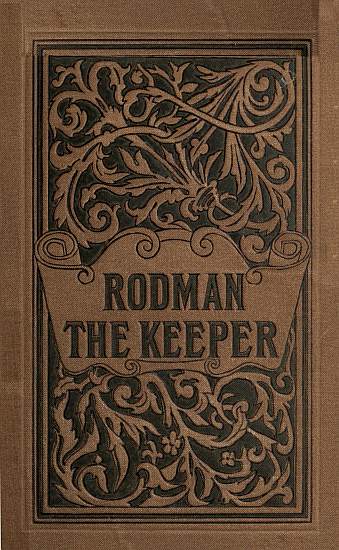
book's cover


from Rodman the Keeper Southern Sketches (1880)


"KEEPER of what? Keeper of the dead. Well, it is easier to keep the dead than the living; and as for the gloom of the thing, the living among whom I have been lately were not a hilarious set."

John Rodman sat in the doorway and looked out over his domain. The little cottage behind him was empty of life save himself alone. In one room the slender appointments provided by Government for the keeper, who being still alive must sleep and eat, made the bareness doubly bare; in the other the desk and the great ledgers, the ink and pens, the register, the loud-ticking clock on the wall, and the flag folded on a shelf, were all for the kept, whose names, in hastily written, blotted rolls of manuscript, were waiting to be transcribed in the new red-bound ledgers in the keeper's best handwriting day by day, while the clock was to tell him the hour when the flag must rise over the mounds where reposed the bodies of fourteen thousand United States soldiers—who had languished where once stood the prison-pens, on the opposite slopes, now fair and peaceful in the sunset; who had fallen by the way in long marches to and fro under the burning sun; who had fought and died on the many battle-fields that reddened the beautiful State, stretching from the peaks of the marble mountains in the smoky west down to the sea-islands of the ocean border. The last rim of the sun's red ball had sunk below the horizon line, and the western sky glowed with deep rose-color, which faded away above into pink, into the salmon-tint, into shades of that far-away heavenly emerald which the brush of the earthly artist can never reproduce, but which is found sometimes in the iridescent heart of the opal. The small town, a mile distant, stood turning its back on the cemetery; but the keeper could see the pleasant, rambling old mansions, each with its rose-garden and neglected outlying fields, the empty negro quarters falling into ruin, and everything just as it stood when on that April morning the first gun was fired on Sumter; apparently not a nail added, not a brushful of paint applied, not a fallen brick replaced, or latch or lock repaired. The keeper had noted these things as he strolled through the town, but not with surprise; for he had seen the South in its first estate, when, fresh, strong, and fired with enthusiasm, he, too, had marched away from his village home with the colors flying above and the girls waving their handkerchiefs behind, as the regiment, a thousand strong, filed down the dusty road. That regiment, a weak, scarred two hundred, came back a year later with lagging step and colors tattered and scorched, and the girls could not wave their handkerchiefs, wet and sodden with tears. But the keeper, his wound healed, had gone again; and he had seen with his New England eyes the magnificence and the carelessness of the South, her splendor and negligence, her wealth and thriftlessness, as through Virginia and the fair Carolinas, across Georgia and into sunny Florida, he had marched month by month, first a lieutenant, then captain, and finally major and colonel, as death mowed down those above him, and he and his good conduct were left. Everywhere magnificence went hand in hand with neglect, and he had said so as chance now and then threw a conversation in his path.

****
I like this cemetery because it is the original resting place of the
   dead who lie beneath. They were not brought here from distant
   places, gathered up by contract, numbered, and described like so
   much merchandise; their first repose has not been broken, their
   peace has been undisturbed. Hasty burials the prison authorities
   gave them; the thin bodies were tumbled into the trenches by men
   almost as thin.... There were not many prayers, no tears, as the
   dead-carts went the rounds. But the prayers had been said, and the
   tears had fallen, while the poor fellows were still alive in the pens
   yonder.
*****
Southern gentlemen feign to know nothing of Andersonville. They
   utterly ignore its existence.... I procured and carefully
   searched, not only railroad maps, but all others to be found at
   bookstores, and on none--not even the railroad guides--can this
   place be discovered, although it is a station on the Central
   Railroad of Georgia. Some told me it was on the line between
   Georgia and South Carolina in Anderson County; others said there
   was no such place.


Constance Fenimore Woolson


from Mentone, Cairo and Corfu. Cairo in 1890. (1895)

But in Cairo, at least, the work of repairing goes on very slowly; three hundred mosques, probably, out of the four hundred still remain untouched, and many of these are adorned with a delicate beauty which is unrivalled. I know no quest so enchanting as a search through the winding lanes of the old quarters for these gems of Saracenic taste, which no guide-book has as yet chronicled, no dragoman discovered. The street is so narrow that your donkey fills almost all the space; passers-by are obliged to flatten themselves against the walls in response to the Oriental adjurations of your donkey-boy behind: "Take heed, O maid!" "Your foot, O chief!" Presently you see a minaret—there is always a minaret somewhere; but it is not always easy to find the mosque to which it belongs, hidden, perhaps, as it is, behind other buildings in the crowded labyrinth. At length you observe a door with a dab or two of the well-known Saracenic honeycomb-work above it; instantly you dismount, climb the steps, and look in. You are almost sure to find treasures, either fragments of the pearly Cairo mosaic, or a wonderful ceiling, or gilded Kufic (old Arabian text) inscriptions and arabesques, or remains of the ancient colored glass which changes its tint hour by hour. Best of all, sometimes you find a space open to the sky, with a fountain in the centre, the whole surrounded by arcades of marble columns adorned with hanging lamps (or, rather, with the bronze chains which once carried the lamps), and with suspended ostrich eggs—the emblems of good-luck. One day, when my donkey was making his way through a dilapidated region, I came upon a mosque so small that it seemed hardly more than a base for its exquisite minaret, which towered to an unusual height above it. Of course I dismounted. The little mosque was open; but as it was never visited by strangers, it possessed no slippers, and without coverings of some kind it was impossible that unsanctified shoes, such as mine, should touch its matted floor; the bent, ancient guardian glared at me fiercely for the mere suggestion. One sees sometimes (even in 1890) in the eyes of old men sitting in the mosques the original spirit of Islam shining still. Once their religion commanded the sword; they would like to grasp it again, if they could. It was suggested that the matting might, for a backsheesh, be rolled up and put away, as the place was small. But the stern old keeper remained inflexible. Then the offer was made that so many piasters—ten (that is, fifty cents)—would be given to the blind. Now the blind are sacred in Cairo; this offer, therefore, was successful; all the matting was carefully rolled and stacked in a corner, the three or four Muslims present withdrew to the door, and the unbeliever was allowed to enter. She found herself in a temple of color which was incredibly rich. The floor was of delicate marble, and every inch of the walls was covered with a mosaic of porphyry and jasper, adorned with gilded inscriptions and bands of Kufic text; the tall pulpit, made of mahogany-colored wood, was carved from top to bottom in intricate designs, and ornamented with odd little plaques of fretted bronze; the sacred niche was lined with alabaster, turquoise, and gleaming mother-of-pearl; the only light came through the thick glass of the small windows far above, in downward-falling rays of crimson, violet, and gold. The old mosaic-work of the Cairo mosques is composed of small plates of marble and of mother-of-pearl arranged in geometrical designs; the delicacy of the minute cubes employed, and the intricacy of the patterns, are marvellous; the color is faint, unless turquoise has been added; but the glitter of the mother-of-pearl gives the whole an appearance like that of jewelry. Upon our departure five blind men were found drawn up in a line at the door. It would not have been difficult to collect fifty.

Constance Fenimore Woolson


Detail from Woman Reading / La Liseuse (1895), oil on board, Henri Matisse


from Castle Nowhere: Lake-Country Sketches (1875)

'Come, then, Jarvis.' And she led the way through a low door into a long narrow room with a row of little square windows on each side all covered with little square white curtains. The walls and ceiling were planked and the workmanship of the whole rude and clumsy; but a gay carpet covered the floor, a chandelier adorned with lustres, hung from a hook in the ceiling, large gilded vases and a mirror in a tarnished gilt frame adorned a shelf over the hearth, mahogany chairs stood in ranks against the wall under the little windows and a long narrow table ran down the centre of the apartment from end to end. It all seemed strangely familiar; of what did it remind him? His eyes fell upon the table-legs; they were riveted to the floor. Then it came to him at once,—the long narrow cabin of a lake steamer.

'I wonder if it is not anchored after all,' he thought.

'Just a few shavings and one little stick, Lorez,' said Silver; 'enough to give us light and drive away the damp.'

Up flared the blaze and spread abroad the dear home feeling. (O hearth-fire, good genius of home, with thee a log-cabin is cheery and bright, without thee the palace a dreary waste!)

'And now, while Lorez is preparing supper, you will come and see my pets,' said Silver, in her soft tone of unconscious command.

'By all means,' replied Waring. 'Anything in the way of mermaidens?'

'Mermaidens dwell in the water, they cannot live in houses as we can; did you not know that? I have seen them on moonlight nights, and so has Lorez; but Aunt Shadow never saw them.'

'Another member of the family,—Aunt Shadow?'

'Yes,' replied Silver; 'but she is not here now. She went away one night when I was asleep. I do not know why it is,' she added sadly, 'but if people go away from here in the night they never come back. Will it be so with you, Jarvis?'

'No; for I will take you with me,' replied the young man lightly.

'Very well; and father will go too, and Lorez,' said Silver.

To this addition, Waring, like many another man in similar circumstances, made no reply. But Silver did not notice the omission. She had opened a door, and behold, they stood together in a bower of greenery and blossom, flowers growing everywhere,—on the floor, up the walls, across the ceiling, in pots, in boxes, in baskets, on shelves, in cups, in shells, climbing, crowding each other, swinging, hanging, winding around everything,—a riot of beauty with perfumes for a language. Two white gulls stood in the open window and gravely surveyed the stranger.

'They stay with me almost all the time,' said the water-maiden; 'every morning they fly out to sea for a while, but they always come back.'

Then she flitted to and fro, kissed the opening blossoms and talked to them, tying back the more riotous vines and gravely admonishing them.

'They are so happy here,' she said; 'it was dull for them on shore. I would not live on the shore! Would you?'

'Certainly not,' replied Waring, with an air of having spent his entire life upon a raft. 'But you did not find all these blossoms on the shores about here, did you?'

'Father found them,—he finds everything; in his boat almost every night is something for me. I hope he will come soon; he will be so glad to see you.'

'Will he? I wish I was sure of that,' thought Waring. Then aloud,
'Has he any men with him?' he asked carelessly.

'O no; we live here all alone now,—father, Lorez, and I.'

'But you were expecting a Jacob?'

'I have been expecting Jacob for more than two years. Every night I watch for him, but he comes not. Perhaps he and Aunt Shadow will come together,—do you think they will?' said Silver, looking up into his eyes with a wistful expression.


Charles W. Chestnutt


from Baxter's Procrustes (1904)

The club had always appreciated the value of uncut copies, but this financial indorsement en- hanced their desirability immensely. This rise in the Essay on Pipes was not without a sympathetic effect upon all the club publications. The Emerson essay rose from three dollars to seventeen, and the Thoreau, being by an author less widely read, and by his own confession commercially unsuccessful, brought a somewhat higher figure. The prices, thus inflated, were not permitted to come down appreciably. Since every member of the club possessed one or more of these valuable editions, they were all manifestly interested in keeping up the price. The publication, however, which brought the highest prices, and, but for the sober second thought, might have wrecked the whole system, was Baxter’s Procrustes.

Baxter was, perhaps, the most scholarly member of the club. A graduate of Harvard, he had traveled extensively, had read widely, and while not so enthusiastic a collector as some of us, possessed as fine a private library as any man of his age in the city. He was about thirty-five when he joined the club, and apparently some bitter experience—some disappointment in love or ambition—had left its mark upon his character. With light, curly hair, fair complexion, and gray eyes, one would have expected Baxter to be genial of temper, with a tendency toward wordiness of speech. But though he had oc- casional flashes of humor, his ordinary demeanor was charac- terized by a mild cynicism, which, with his gloomy pessimistic

page3image4092850288

philosophy, so foreign to the temperament that should ac- company his physical type, could only be accounted for upon the hypothesis of some secret sorrow such as I have sug- gested. What it might be no one knew. He had means and so- cial position, and was an uncommonly handsome man. The fact that he remained unmarried at thirty-five furnished some support for the theory of a disappointment in love, though this the several intimates of Baxter who belonged to the club were not able to verify.

It had occurred to me, in a vague way, that perhaps Baxter might be an unsuccessful author. That he was a poet we knew very well, and typewritten copies of his verses had occasionally circulated among us. But Baxter had always expressed such a profound contempt for modern literature, had always spoken in terms of such unmeasured pity for the slaves of the pen, who were dependent upon the whim of an undiscriminating public for recognition and a livelihood, that no one of us had ever suspected him of aspirations toward publication, until, as I have said, it occurred to me one day that Baxter’s attitude with regard to publication might be viewed in the light of ef- fect as well as of cause,—that his scorn of publicity might as easily arise from failure to achieve it, as his never having pub- lished might be due to his preconceived disdain of the vulgar popularity which one must share with the pugilist or balloon- ist of the hour.

Constance Fenimore Woolson


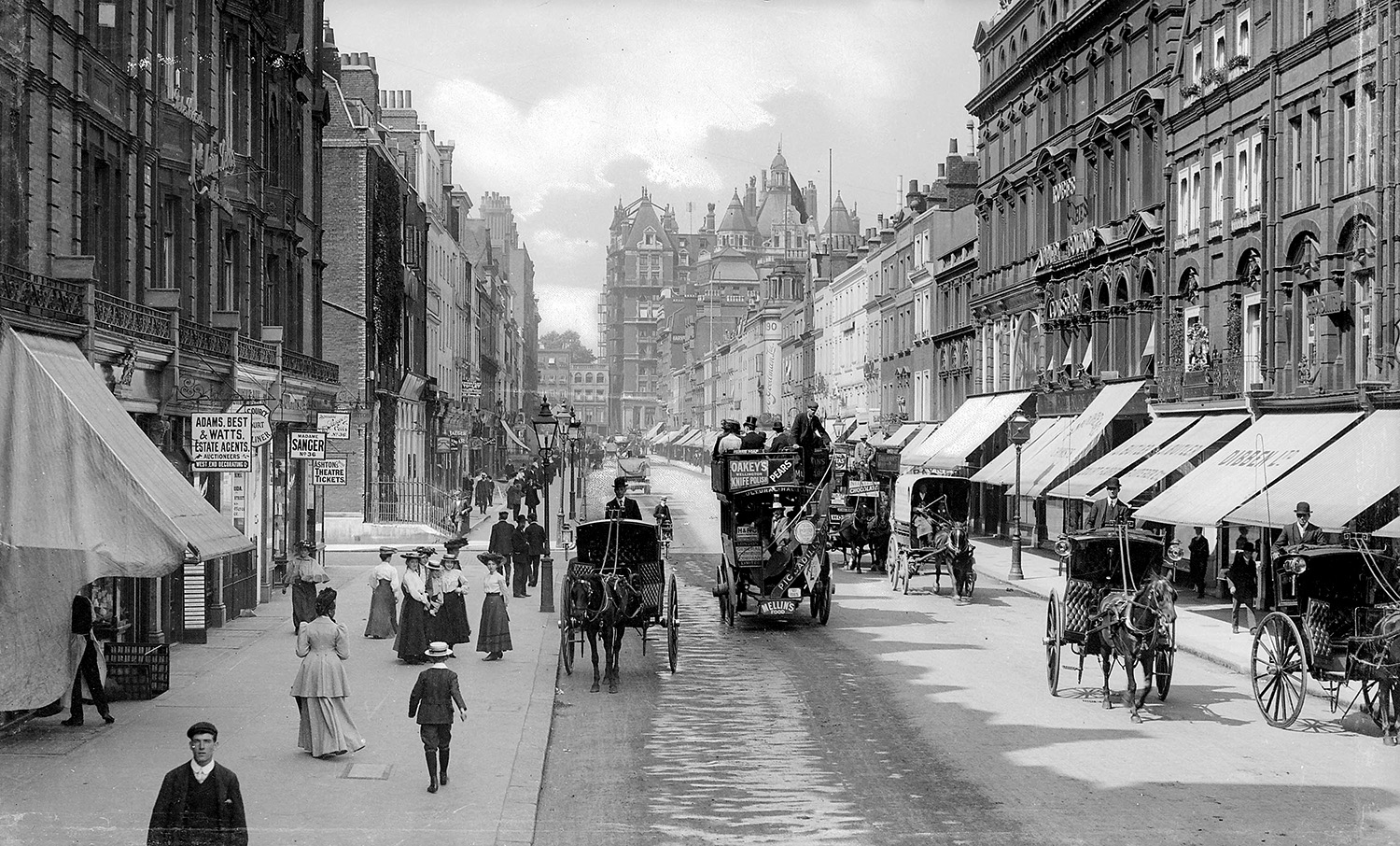
Sloane Street, c. 1900, a short walk north of the townhouse where Woolson stayed during her first winter in London. The dominant building at the end of the street is an apartment block built in 1882, the year before she arrived. After a fire in 1904, it reopened as the Hyde Park Hotel (currently the Mandarin Oriental Hyde Park). The horse-drawn omnibus at center boasts then-ubiquitous advertisements for Pears Soap and Oakey’s Knife Polish. In her story, which is set in 1892, Woolson describes omnibuses passing by on Sloane Street: “their sides bore advice (important in the blackest of towns) about soap.” (Photo by LL/Roger Viollet via Getty Images) 


from In Sloane Street (Originally published in Harper's Bazar, June 11, 1892.


“WELL, I’ve seen the National Gallery, and that’s over,” said Mrs . Moore, taking off her smart little bonnet and delicately drying with her handkerchief two drops which were

visible on its ribbons . “And I think I’m very enterprising . You would never have got Isabella to go in such a rain .”

“Of course not . Isabella likes to stay at home and read Me- morials of a Quiet Life; it makes her feel so superior,” answered Gertrude Remington .

“Superior?” commented Mrs . Moore, contemptuously . “Mary would not have gone, either .”

“No . But Mary—that’s another affair . Mary would not touch the Memorials with the tip of her finger, and she wouldn’t have minded the rain; but she doesn’t care for galleries . With her great love for art, she prefers a book, or, rather, certain books, about pictures, to the pictures themselves . For she thinks that painters, as a rule, are stupid—have no ideas; whereas the art critics—that is, the two or three she likes—really know what a picture means .”

“Better than the painters themselves?”

“Oh, far!” answered Miss Remington . “Mary thinks that the work of the painters themselves is merely mechanical; it is the art critic—always her two or three—who discovers the soul in their productions .”

“The only art critics I know are Mrs . Jameson and Ruskin,” remarked Mrs . Moore, in a vague tone, as she drew off her closely fitting jacket by means of a contortion .

“To Mary, those two are Tupper and Sandford and Mer- ton,” responded Miss Remington . “And I agree with her about Ruskin; all his later books are the weakest twaddle in the world —violent, ignorant, childish .”

Henry James


                                   Portrait by John Singer Sargent.Lady Agnew of Lochnaw. (1892)


from The Princess Casamassima (1886)

Hyacinth lingered in the street, a certain distance from the house, watching for Schinkel’s exit and prepared to remain there if necessary till the dawn of another day. He had said to his friends, just before, that the manner in which the communication they looked so askance at should reach him was none of his business—it might reach him as it could. This was true enough in theory, but in fact his desire was overwhelming to know what Madame Poupin had meant by her allusion to a letter, destined for him, in Schinkel’s possession—an allusion confirmed by Schinkel’s own virtual acknowledgment. It was indeed this eagerness that had driven him out of the house, for he had reason to believe that the German would not fail him, and it galled his suspense to see the foolish Poupins try to interpose, to divert the missive from its course. He waited and waited, in the faith that Schinkel was dealing with them in his slow, categorical Teutonic way, and only objurgated the cabinet-maker for having in the first place paltered with his sacred trust. Why hadn’t he come straight to him—whatever the mysterious document was—instead of talking it over with French featherheads? Passers were rare, at this hour, in Lisson Grove, and lights were mainly extinguished; there was nothing to look at but the vista of the low black houses, the dim, interspaced street-lamps, the prowling cats who darted occasionally across the road, and the terrible, mysterious, far-off stars, which appeared to him more than ever to see everything and to tell nothing. A policeman creaked along on the opposite side of the way, looking across at him as he passed, and stood for some minutes on the corner, as if to keep an eye on him. Hyacinth had leisure to reflect that the day was perhaps not far off when a policeman might have his eye on him for a very good reason—might walk up and down, pass and repass, as he mounted guard over him.

It seemed horribly long before Schinkel came out of the house, but it was probably only half an hour. In the stillness of the street he heard Poupin let his visitor out, and at the sound he stepped back into the recess of a doorway on the same side, so that, in looking out, the Frenchman should not see him waiting. There was another delay, for the two stood talking together interminably and in a low tone on the doorstep. At last, however, Poupin went in again, and then Schinkel came down the street towards Hyacinth, who had calculated that he would proceed in that direction, it being, as Hyacinth happened to know, that of his own lodging. After he had heard Poupin go in he stopped and looked up and down; it was evidently his idea that Hyacinth would be waiting for him. Our hero stepped out of the shallow recess in which he had been flattening himself, and came straight to him, and the two men stood there face to face, in the dusky, empty, sordid street.

“

Henry James

 Henry James

Photograph by Alice Broughton (1906)


from The Ambassadors (1903) 

Strether’s first question, when he reached the hotel, was about his friend; yet on his learning that Waymarsh was apparently not to arrive till evening he was not wholly disconcerted. A telegram from him bespeaking a room “only if not noisy,” reply paid, was produced for the enquirer at the office, so that the understanding they should meet at Chester rather than at Liverpool remained to that extent sound. The same secret principle, however, that had prompted Strether not absolutely to desire Waymarsh’s presence at the dock, that had led him thus to postpone for a few hours his enjoyment of it, now operated to make him feel he could still wait without disappointment. They would dine together at the worst, and, with all respect to dear old Waymarsh—if not even, for that matter, to himself—there was little fear that in the sequel they shouldn’t see enough of each other. The principle I have just mentioned as operating had been, with the most newly disembarked of the two men, wholly instinctive—the fruit of a sharp sense that, delightful as it would be to find himself looking, after so much separation, into his comrade’s face, his business would be a trifle bungled should he simply arrange for this countenance to present itself to the nearing steamer as the first “note,” of Europe. Mixed with everything was the apprehension, already, on Strether’s part, that it would, at best, throughout, prove the note of Europe in quite a sufficient degree.

That note had been meanwhile—since the previous afternoon, thanks to this happier device—such a consciousness of personal freedom as he hadn’t known for years; such a deep taste of change and of having above all for the moment nobody and nothing to consider, as promised already, if headlong hope were not too foolish, to colour his adventure with cool success. There were people on the ship with whom he had easily consorted—so far as ease could up to now be imputed to him—and who for the most part plunged straight into the current that set from the landing-stage to London; there were others who had invited him to a tryst at the inn and had even invoked his aid for a “look round” at the beauties of Liverpool; but he had stolen away from every one alike, had kept no appointment and renewed no acquaintance, had been indifferently aware of the number of persons who esteemed themselves fortunate in being, unlike himself, “met,” and had even independently, unsociably, alone, without encounter or relapse and by mere quiet evasion, given his afternoon and evening to the immediate and the sensible. They formed a qualified draught of Europe, an afternoon and an evening on the banks of the Mersey, but such as it was he took his potion at least undiluted. He winced a little, truly, at the thought that Waymarsh might be already at Chester; he reflected that, should he have to describe himself there as having “got in” so early, it would be difficult to make the interval look particularly eager; but he was like a man who, elatedly finding in his pocket more money than usual, handles it a while and idly and pleasantly chinks it before addressing himself to the business of spending. That he was prepared to be vague to Waymarsh about the hour of the ship’s touching, and that he both wanted extremely to see him and enjoyed extremely the duration of delay—these things, it is to be conceived, were early signs in him that his relation to his actual errand might prove none of the simplest. He was burdened, poor Strether—it had better be confessed at the outset—with the oddity of a double consciousness. There was detachment in his zeal and curiosity in his indifference.

Henry James

Henry James
From a Drawing by John S. Sargent R. A. 1886.

                portrait by John Singer Sargent (1886)


from The Wings of the Dove (1902)

She waited, Kate Croy, for her father to come in, but he kept her unconscionably, and there were moments at which she showed herself, in the glass over the mantel, a face positively pale with the irritation that had brought her to the point of going away without sight of him. It was at this point, however, that she remained; changing her place, moving from the shabby sofa to the armchair upholstered in a glazed cloth that gave at once—she had tried it—the sense of the slippery and of the sticky. She had looked at the sallow prints on the walls and at the lonely magazine, a year old, that combined, with a small lamp in colored glass and a knitted white centre-piece wanting in freshness, to enhance the effect of the purplish cloth on the principal table; she had above all, from time to time, taken a brief stand on the small balcony to which the pair of long windows gave access. The vulgar little street, in this view, offered scant relief from the vulgar little room; its main office was to suggest to her that the narrow black house-fronts, adjusted to a standard that would have been low even for backs, constituted quite the publicity implied by such privacies. One felt them in the room exactly as one felt the room—the hundred like it, or worse—in the street. Each time she turned in again, each time, in her impatience, she gave him up, it was to sound to a deeper depth, while she tasted the faint, flat emanation of things, the failure of fortune and of honour. If she continued to wait it was really, in a manner, that she might not add the shame of fear, of individual, personal collapse, to all the other shames. To feel the street, to feel the room, to feel the table-cloth and the centre-piece and the lamp, gave her a small, salutary sense, at least, of neither shirking nor lying. This whole vision was the worst thing yet—as including, in particular, the interview for which she had prepared herself; and for what had she come but for the worst? She tried to be sad, so as not to be angry; but it made her angry that she couldn’t be sad. And yet where was misery, misery too beaten for blame and chalk-marked by fate like a “lot” at a common auction, if not in these merciless signs of mere mean, stale feelings?

Her father’s life, her sister’s, her own, that of her two lost brothers—the whole history of their house had the effect of some fine florid, voluminous phrase, say even a musical, that dropped first into words, into notes, without sense, and then, hanging unfinished, into no words, no notes at all. Why should a set of people have been put in motion, on such a scale and with such an air of being equipped for a profitable journey, only to break down without an accident, to stretch themselves in the wayside dust without a reason?

Henry James


Henry James and American Painting at the Morgan Library

portrait by John Singer Sargent. oil on canvas (1913)


from The Bostonians (1886)

 "And who is Miss Birdseye?"


"She is one of our celebrities. She is the woman in the world, I suppose, who has laboured most for every wise reform. I think I ought to tell you," Miss Chancellor went on in a moment, "she was one of the earliest, one of the most passionate, of the old Abolitionists."


She had thought, indeed, she ought to tell him that, and it threw her into a little tremor of excitement to do so. Yet, if she had been afraid he would show some irritation at this news, she was disappointed at the geniality with which he exclaime

"Why, poor old lady—she must be quite mature!"


It was therefore with some severity that she rejoined:


"She will never be old. She is the youngest spirit I know. But if you are not in sympathy, perhaps you had better not come," she went on.


"In sympathy with what, dear madam?" Basil Ransom asked, failing still, to her perception, to catch the tone of real seriousness. "If, as you say, there is to be a discussion, there will be different sides, and of course one can't sympathise with both."


"Yes, but every one will, in his way—or in her way—plead the cause of the new truths. If you don't care for them, you won't go with us."


"I tell you I haven't the least idea what they are! I have never yet encountered in the world any but old truths—as old as the sun and moon. How can I know? But do take me; it's such a chance to see Boston."


"It isn't Boston—it's humanity!" Miss Chancellor, as she made this remark, rose from her chair, and her movement seemed to say that she consented. But before she quitted her kinsman to get ready, she observed to him that she was sure he knew what she meant; he was only pretending he didn't.


"Well, perhaps, after all, I have a general idea," he confessed; "but don't you see how this little reunion will give me a chance to fix it?"


She lingered an instant, with her anxious face. "Mrs. Farrinder will fix it!" she said; and she went to prepare herself.


It was in this poor young lady's nature to be anxious, to have scruple within scruple and to forecast the consequences of things. She returned in ten minutes, in her bonnet, which she had apparently assumed in recognition of Miss Birdseye's asceticism. As she stood there drawing on her gloves—her visitor had fortified himself against Mrs. Farrinder by another glass of wine—she declared to him that she quite repented of having proposed to him to go; something told her that he would be an unfavourable element.


"Why, is it going to be a spiritual séance?" Basil Ransom asked.


"Well, I have heard at Miss Birdseye's some inspirational speaking." Olive Chancellor was determined to look him straight in the face as she said this; her sense of the way it might strike him operated as a cogent, not as a deterrent, reason.


"Why, Miss Olive, it's just got up on purpose for me!" cried the young Mississippian, radiant, and clasping his hands. She thought him very handsome as he said this, but reflected that unfortunately men didn't care for the truth, especially the new kinds, in proportion as they were good-looking. She had, however, a moral resource that she could always fall back upon; it had already been a comfort to her, on occasions of acute feeling, that she hated men, as a class, anyway. "And I want so much to see an old Abolitionist; I have never laid eyes on one," Basil Ransom added.


D. H. Lawrence

 from Pansies THE WHITE HORSE The youth walks up to the white horse, to put its halter on and the horse looks at him in silence. They are s...