Ted Berrigan


Ted Berrigan Reads At The Village Theatre


Sonnets for Tom Clark

            (in recognition of his kindness)

 1.

In The Early Morning Rain
To my family & friends          “Hello”
And money. With something inside us we float up
On this electric chair each breath nearer the last
Now is spinning
Seven thousand feet over / The American Midwest
Gus walks up under the arb-light as far as the first person
The part that goes over the fence last
And down in a green forest ravine            near to “her”
Winds in the stratosphere
                                                Apologize to the malcontents
Downstairs. The black bag & the wise man may be found
                 in the brain-room.
what sky out there                     Take it away
                                   & it’s off
one foot
               is expressing itself as continuum
the other, sock


2.

Tomorrow.          I need to kill
Blank mind part                     Confusions of the cloth
White snow whirls everywhere.           Across the fields
in the sky the
                          Soft, loose  
stars swarm. Nature makes my teeth “to hurt”
shivering now on 32nd street in my face & in my head
does Bobby Dylan ever come around here?    listen
it’s alive        where exposed nerve jangles
& I         looming over Jap’s American flag
In Public, In Private        The Sky Pilot In No-Man’s-Land
The World Number 14        is tipsy as pinballs on the ocean
We are bored through......through......through with our professionalism
Outside her
Windows

Dylan Thomas

 I See The Boys Of Summer


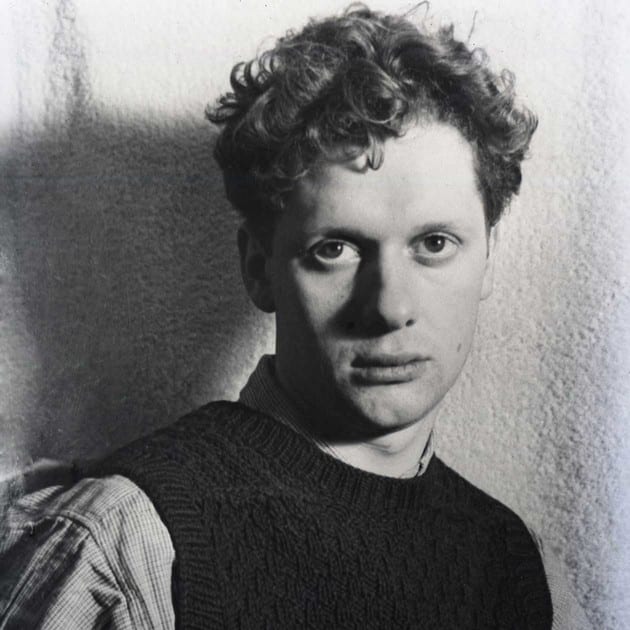
 The Welsh poet Dylan Thomas, whose birth centenary is Monday.

I

I see the boys of summer in their ruin
Lay the gold tithings barren,
Setting no store by harvest, freeze the soils;
There in their heat the winter floods
Of frozen loves they fetch their girls,
And drown the cargoed apples in their tides.

These boys of light are curdlers in their folly,
Sour the boiling honey;
The jacks of frost they finger in the hives;
There in the sun the frigid threads
Of doubt and dark they feed their nerves;
The signal moon is zero in their voids.

I see the summer children in their mothers
Split up the brawned womb's weathers,
Divide the night and day with fairy thumbs;
There in the deep with quartered shades
Of sun and moon they paint their dams
As sunlight paints the shelling of their heads.

I see that from these boys shall men of nothing
Stature by seedy shifting,
Or lame the air with leaping from its hearts;
There from their hearts the dogdayed pulse
Of love and light bursts in their throats.
O see the pulse of summer in the ice.

II

But seasons must be challenged or they totter
Into a chiming quarter
Where, punctual as death, we ring the stars;
There, in his night, the black-tongued bells
The sleepy man of winter pulls,
Nor blows back moon-and-midnight as she blows.

We are the dark deniers, let us summon
Death from a summer woman,
A muscling life from lovers in their cramp,
From the fair dead who flush the sea
The bright-eyed worm on Davy's lamp,
And from the planted womb the man of straw.

We summer boys in this four-winded spinning,
Green of the seaweed's iron,
Hold up the noisy sea and drop her birds,
Pick the world's ball of wave and froth
To choke the deserts with her tides,
And comb the county gardens for a wreath.

In spring we cross our foreheads with the holly,
Heigh ho the blood and berry,
And nail the merry squires to the trees;
Here love's damp muscle dries and dies,
Here break a kiss in no love's quarry.
O see the poles of promise in the boys.

III

I see the boys of summer in their ruin.
Man in his maggot's barren.
And boys are full and foreign in the pouch.
I am the man your father was.
We are the sons of flint and pitch.
O see the poles are kissing as they cross.


Dylan Thomas


Image result for dylan thomas


THE FORCE THAT DRIVES THE GREEN FUSE DRIVES THE FLOWER

The force that through the green fuse drives the flower
Drives my green age; that blasts the roots of trees
Is my destroyer.
And I am dumb to tell the crooked rose
My youth is bent by the same wintry fever.

The force that drives the water through the rocks
Drives my red blood; that dries the mouthing streams
Turns mine to wax.
And I am dumb to mouth unto my veins
How at the mountain spring the same mouth sucks.

The hand that whirls the water in the pool
Stirs the quicksand; that ropes the blowing wind
Hauls my shroud sail.
And I am dumb to tell the hanging man
How of my clay is made the hangman's lime.

The lips of time leech to the fountain head;
Love drips and gathers, but the fallen blood
Shall calm her sores.
And I am dumb to tell a weather's wind
How time has ticked a heaven round the stars.

And I am dumb to tell the lover's tomb
How at my sheet goes the same crooked worm.

John Ashbery


Three Quarter Length Poster featuring the drawing The Oath Of The Tennis Court #1 by Print Collector


Two Sonnets

from The Tennis Court Oath (1962)

                              I. DIDO
	 
        The body’s products become
	Fatal to it.  Our spit
	Would kill us, but we
	Die of our heat.
	Though I say the things I wish to say
	They are needless, their own flame conceives it.
	So I am cheated of perfection.
	 
                              II. THE IDIOT
	 
        O how this sullen, careless world
	Ignorant of me is!  These rocks, those homes
	Know not the touch of my flesh, now is there one tree
	Whose shade has known me for a friend.
	I’ve wandered the wide world over.
	No man I’ve known, no friendly beast
	Has come and put its nose into my hands.
	No maid has welcomed my face with a kiss.
	 
        Yet once, as I took passage
	From Gibraltar to Cape Horn
	I met some friendly mariners on the boat
	And as we struggled to keep the ship from sinking
	The very waves seemed friendly, and the sound
	The pray made as it hit the front of the boat.

Here is a transcription of Ashbery’s remarks:

“The picture on the jacket was supplied by Wesleyan. It seems to be a contemporary print of the event at Versailles.  I had hoped they would use drawings from Jacques-Louis David for his vast painting ‘The Tennis Court Oath.’  It was apparently his practice to draw figures without clothes first and add them later.  These drawings show naked men leaping joyfully in the air, waving their hats, which creates a bizarre effect.

I had very little input into the production and I suspect the press wasn’t at all happy with it (though it has remained continuously in print since 1962).  I had submitted it at the urgent request of John Hollander, who was a longtime supporter of my work and (just guessing here) managed to get it accepted over the objections of the other jurors.  I only met John some time later when he was passing through Paris, and would like to take this occasion to mention what a lovely human being he was, totally devoted to poetry.”

In addition to the Ashbery, there are lots of other fascinating books to check out here (although there seem to be only two volumes of poems included, a book by Rita Dove and Ashbery’s).

And, if any of you are in the market for a very special first edition of the Tennis Court Oath or many other wonderful books, be sure to head to Christie’s on December 2, wallet in hand!

Christian Bok


Euonia

Jump to ratings and revieEuonia

from Chapter "I"


for Dick Higgins


Writing is inhibiting. Sighing, I sit, scribbling in ink

this pidgin script. I sing with nihilistic witticism,

disciplining signs with trifling gimmicks — impish

hijinks which highlight stick sigils. Isn’t it glib?

Isn’t it chic? I fit childish insights within rigid limits,

writing shtick which might instill priggish misgiv-

ings in critics blind with hindsight. I dismiss nit-

picking criticism which flirts with philistinism. I

bitch; I kibitz — griping whilst criticizing dimwits,

sniping whilst indicting nitwits, dismissing simplis-

tic thinking, in which philippic wit is still illicit.


Pilgrims, digging in shifts, dig till midnight in mining

pits, chipping flint with picks, drilling schist with drills,

striking it rich mining zinc. Irish firms, hiring micks

whilst firing Brits, bring in smiths with mining skills:

kilnwrights grilling brick in brickkilns, millwrights

grinding grist in gristmills. Irish tinsmiths, fiddling

with widgits, fix this rig, driving its drills which spin

whirring drillbits. I pitch in, fixing things. I rig this

winch with its wiring; I fit this drill with its piping. I

dig this ditch, filling bins with dirt, piling it high, sift-

ing it, till I find bright prisms twinkling with glitz.


                    Christian Bök, “From Chapter I” from Eunoia


Anne Carson

Anne Carson


                      An Evening with Joseph Conrad

Joseph Conrad gave a reading at the London Library. A red-haired woman came up afterward. He had seen her circling earlier, taking a chair at the back, but he had not troubled about it. “I knew you in the Congo,” she said now. “I knew your wife.” My wife? he thought, but, as always after a reading, in the retreating roar of his own soul he could barely hear her or remember how English worked. Had she said “life,” not “wife”? Her voice, that of a crow, thrust at him—some weekend they’d “all spent together” and he’d sent her a letter the next day, a poem. Dread rose at the back of his mind; a parcel broke. He turned away, busied himself. He blamed, abhorred the touch of a past time; it surprised him how much. She followed him to the dinner that Charles (the London Librarian) had arranged at a nearby bistro, hurrying along behind everyone else, and, with the touch of his wife or his life burning like a toxin on his inside skin, Joseph Conrad could not meet her eyes or let pathos come clouding into him. When she seated herself at the foot of the table and was speaking loudly to anyone who listened, he felt the pluck of it on the side of his head but did not turn, he had to continue, now he’d begun, it was a long dinner. It was unjust. In other contexts, he admired perseverance. She was drowning. He did not turn. The light of pure reason, Joseph Conrad liked to say, resembles electricity in being cold. Proud statements like this came to him now and again when he was swimming but afterward seemed a bit off. No, it was a little nightmare, it was a rescue he could not carry out (and he was a rescuer).

But eventually the dinner ended. It was still 1907. No one had drowned. Shrugging into coats, they said hearty farewell things. He did not catch her eye. All left together to walk back toward the Library and go their ways. It was an early winter night. He began to feel fundamentally impatient with himself, hot with cowardice. He dropped back to walk beside her. His heartbeat was too fast. She did not seem surprised. An unknownness enveloped them, as if they were playing a game, as if they were draped in cloth or lost in old rooms. How they got to talking about white bread he could not remember afterward, but it shone in his mind, this conversation, as the bread had shone, and he was trying to tell her all that. Maybe she had mentioned lining up for bread in the early-morning dusk, sent out by her mother, running home with a loaf as heavy as two schoolbooks. When one dreamed of bread even now, Joseph Conrad agreed with her, it was not the rough black bread of childhood. Dream bread, mythic bread, was as white as a freshly laundered cuff.


W. H. Auden


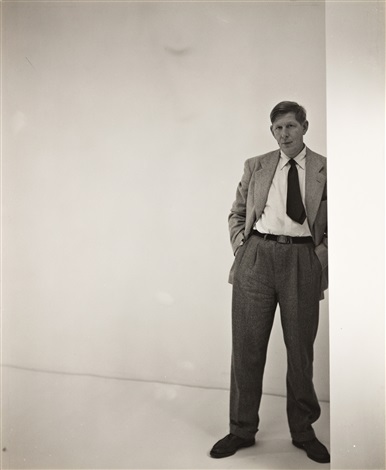
portrait of w.h. auden. by george platt lynes


          Here War Is Simple

Here war is simple like a monument:
A telephone is speaking to a man;
Flags on a map assert that troops were sent;
A boy brings milk in bowls. There is a plan

For living men in terror of their lives,
Who thirst at nine who were to thirst at noon,
And can be lost and are, and miss their wives,
And, unlike an idea, can die too soon.

But ideas can be true although men die,
And we can watch a thousand faces
Made active by one lie
:

And maps can really point to places
Where life is evil now:
Nanking. Dachau.


Franz Wright

 Franz Wright, 1979

WORDS

I don’t know where they come from.
I can summon them
(sometimes I can)
into my mind,
into my fingers,
I don’t know why. Or I’ll suddenly hear them
walking, sometimes
waking—
they don’t often come when I need them.
When I need them most terribly,
never.


D. H. Lawrence


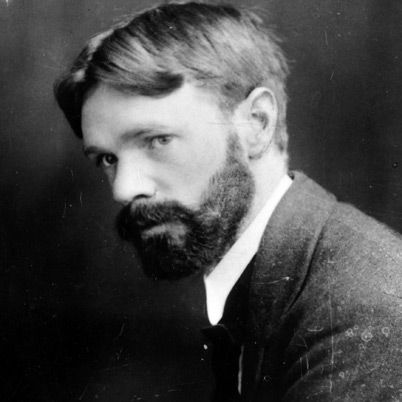
D.H. Lawrence

The Song of a Man Who has Come Through

Not I, not I, but the wind that blows through me!
A fine wind is blowing the new direction of Time.
If only I let it bear me, carry me, if only it carry me!
If only I am sensitive, subtle, oh, delicate, a winged gift!
If only, most lovely of all, I yield myself and am borrowed
By the fine, fine wind that takes its course though the chaos of the world
Like a fine, and exquisite chisel, a wedge-blade inserted;
If only I am keen and hard like the sheer tip of a wedge
Diven by invisible split, we shall come at the wonder, we shall find the Hesperides.

Oh, for the wonder that bubbles into my soul,
I would be a good fountain, a good well-head,
Would blur no whisper, spoil no expression.

What is the knocking?
What is the knocking at the door in the night?
It's somebody wants to do us harm.

No, no, it is the three strange angels.
Admit them, admit them.

Sean Hewitt


sean-hewitt


from All Down Darkness Wild

After some quiet introductions, he nodded towards a thicket of trees and started walking, keeping his distance. I heard the clicking of his lighter as he lit a cigarette, watched him take a deep, slow drag and then exhale the blue smoke into the night-blue air. Then, as I reached him, fumbling: the belt unbuckled, the vertical sound of the zipper. All the time that I was on my knees, I could hear the trembling chain of the spring water clinking and splashing over the far stones. When he finished, I took him all the way into my mouth and held him there as I felt him weaken, then pull back.


Afterwards, I walked to the spring and cupped the ice-cold water into my palm, watched its bright dancing for a second and then lifted it to rinse my mouth. I could still taste him there and couldn't face the long walk home without this little ablution, cleansing myself back into sanctity. As I 

Edith Wharton

https://static.tvtropes.org/pmwiki/pub/images/wharton.png


from Book One Custom of the Country


1

"Undine Spragg!-how can you?" her mother wailed, raising a prematurely wrinkled hand heavy with rings to defend the note which a languid "bell-boy" had just brought in.

But her defense was as feeble as her protest, and she continued to smile on her visitor while Miss Spragg, with a turn of her quick young fingers, possessed herself of the missive and withdrew to the window to read it.

"I guess it's meant for me," she merely threw over her shoulder at her mother.

"Did you ever, Mrs. Heeny?" Mrs. Spragg murmured with deprecating pride.

Herman Hesse

This may contain: an old black and white photo of a man holding a basket


from Chapter 1of Siddhartha


The Son of the Brahmin

In the shade of the house, in the sunlight on the riverbank where the boats were moored, in the shade of the sal wood and the shade of the fig tree, Siddhartha grew up, the Brahmin’s handsome son, the young falcon, together with his friend Govinda, the son of a Brahmin. Sunlight darkened his fair shoulders on the riverbank as he bathed, performed the holy ablutions, the holy sacrifices. Shade poured into his dark eyes in the mango grove as he played with the other boys, listened to his mother’s songs, performed the holy sacrifices, heard the teachings of his learned father and the wise men’s counsels. Siddhartha had long since begun to join in the wise men’s counsels, to practice with Govinda the art of wrestling with words, to practice with Govinda the art of contemplation, the duty of meditation. He had mastered Om, the Word of Words, learned to speak it soundlessly into himself while drawing a breath, to speak it out soundlessly as his breath was released,  his soul collected, brow shining with his mind’s clear thought. He had learned to feel Atman’s presence at the core of his being, inextinguishable, one with the universe.

Joy leaped into his father’s heart at the thought of his son, this studious boy with his thirst for knowledge; he envisioned him growing up to be a great wise man and priest, a prince among Brahmins.

William Golding


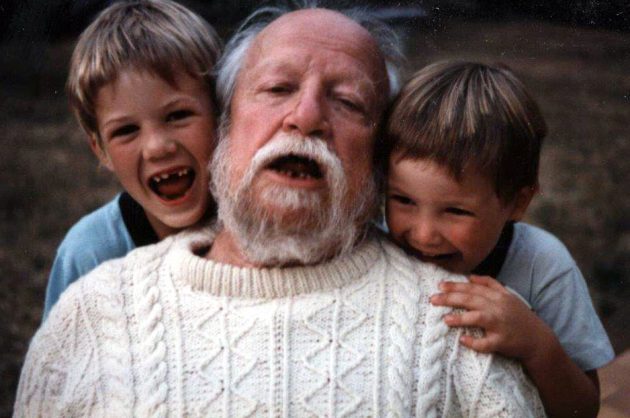
Golding in greyish-white jumper with Roger's older brothers: Nick and Laurie.

From Lord of the Flies

Ralph did a surface dive and swam under water with his eyes open; the sandy edge of the pool loomed up like a hillside. He turned over, holding his nose, and a golden light danced and shattered just over his face. Piggy was looking determined and began to take off his shorts. Presently he was palely and fatly naked. He tiptoed down the sandy side of the pool, and sat there up to his neck in water smiling proudly at Ralph.


    "Aren't you going to swim?"

    Piggy shook his head.

    "I can't swim. I wasn't allowed. My asthma—"

    "Sucks to your ass-mar!"

Amy Lowell

 Young Amy Lowell

Midday And Afternoon 

Swirl of crowded streets. Shock and recoil of traffic. The stock-still brick façade of an old church, against which the waves of people lurch and withdraw. Flare of sunshine down side-streets. Eddies of light in the windows of chemists’ shops, with their blue, gold, purple jars, darting colours far into the crowd. Loud bangs and tremors, murmurings out of high windows, whirring of machine belts, blurring of horses and motors. A quick spin and shudder of brakes on an electric car, and the jar of a church-bell knocking against the metal blue of the sky. I am a piece of the town, a bit of blown dust, thrust along with the crowd. Proud to feel the pavement un der me, reeling with feet. Feet tripping, skipping, lag ging, dragging, plodding doggedly, or springing up and advancing on firm elastic insteps. A boy is selling papers, I smell them clean and new from the press. They are fresh like the air, and pungent as tulips and narcissus. The blue sky pales to lemon, and great tongues of gold blind the shop-windows, putting out their contents in a flood of flame. 


Anthony Hecht


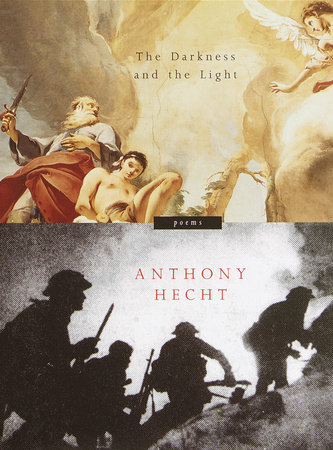
The Darkness and the Light by Anthony Hecht

Sarabande On Attaining The Age Of Seventy-Seven

The harbingers are come.  See, see their mark;
White is their colour; and behold my head.
           — George Herbert
           
Long gone the smoke-and-pepper childhood smell
Of the smoldering immolation of the year,
Leaf-strewn in scattered grandeur where it fell,
Golden and poxed with frost, tarnished and sere.

And I myself have whitened in the weathers
Of heaped-up Januaries as they bequeath
The annual rings and wrongs that wring my withers,
Sober my thoughts, and undermine my teeth.

The dramatis personae of our lives
Dwindle and wizen; familiar boyhood shames,
The tribulations one somehow survives,
Rise smokily from propitiatory flames

Of our forgetfulness until we find
It becomes strangely easy to forgive
Even ourselves with this clouding of the mind,
This cinerous blur and smudge in which we live.

A turn, a glide, a quarter turn and bow,
The stately dance advances; these are airs
Bone-deep and numbing as I should know by now,
Diminishing the cast, like musical chairs.

D. H. Lawrence

 from Pansies THE WHITE HORSE The youth walks up to the white horse, to put its halter on and the horse looks at him in silence. They are s...